Generating qualified leads has always been one of the biggest challenges in B2B marketing. While many companies invest heavily in marketing and sales campaigns, consistently attracting the right prospects remains difficult.
In 2026, the B2B buyer journey has become more complex and more digital than ever. Decision-makers conduct extensive research, compare multiple vendors, and ignore generic outreach that doesn’t address their real needs. As a result, businesses can no longer rely on random tactics or a single channel to generate opportunities.
Successful companies take a different approach. They rely on structured B2B lead generation campaigns built on data, targeted outreach, and consistent demand generation strategies.
In this guide, we’ll explore the most effective B2B lead generation strategies for 2026, helping you build a predictable pipeline of qualified leads and sustainable growth.
What Is B2B Lead Generation?
B2B lead generation is the process of identifying potential business buyers for your product or service and attracting their interest. Marketing and sales teams use different lead generation strategies to capture attention, collect contact information, and guide prospects through the lead generation funnel until they become qualified opportunities.
Because long-term growth depends on reaching the right companies and decision-makers, B2B lead generation is a critical first step in building a predictable sales pipeline.
If you'd like a deeper understanding of the concept, you can read our full guide on What Is B2B Lead Generation? Types & Key Metrics Explained
Why a Strong B2B Lead Generation Strategy Matters?
The B2B buying journey has changed dramatically. Today, most buyers complete much of their research before ever speaking with a vendor. In fact, around 80% of B2B buyers initiate the first contact only after they are already about 70% through their buying journey.
This means decision-makers often evaluate solutions, compare vendors, and define their requirements long before engaging with sales teams. For companies, this shift makes strong B2B lead-generation campaigns and early visibility into the buyer journey more critical than ever.
Without a strong lead generation strategy, businesses face a simple reality:
No leads entering the pipeline means no opportunities, no conversions, and ultimately no revenue
A well-designed lead generation funnel helps businesses:
- Identify and reach ideal customers
- Increase brand visibility and awareness
- Generate qualified opportunities for sales teams
- Improve conversion rates and pipeline flow
- Support long-term revenue growth
In short, successful companies treat lead generation not as a one-off activity, but as a strategic system that combines inbound and outbound channels, data insights, and continuous optimization.
Top B2B Lead Generation Strategies in 2026
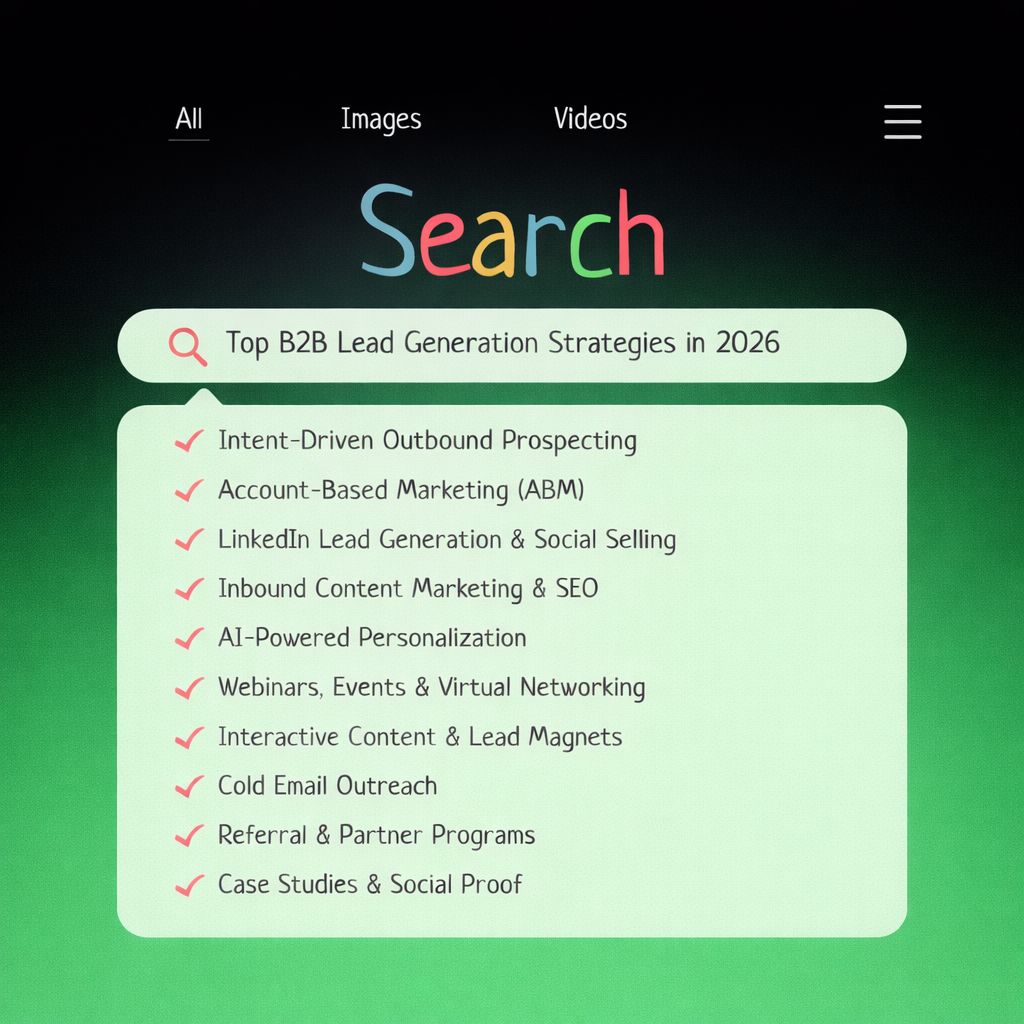
1. Intent-Driven Outbound Prospecting
Outbound remains one of the most effective B2B lead generation strategies, but only when it’s driven by data, not volume. In 2026, the focus has shifted from mass outreach to intent-driven prospecting, where businesses identify prospects actively researching solutions in their category.
Intent data platforms analyze signals such as content consumption, search activity, vendor comparisons, and job postings to detect companies currently in a buying cycle.
By building outbound campaigns around these signals, companies can reach decision-makers at the right moment, increasing response rates, shortening sales cycles, and generating higher-quality leads.
2. Account-Based Marketing (ABM)
Account-Based Marketing flips the traditional B2B lead generation funnel. Account-Based Marketing (ABM) focuses on high-value target accounts instead of a broad audience. Businesses identify companies that match their ideal customer profile and run personalized campaigns across channels like email, LinkedIn, ads, and events to reach multiple decision-makers.
By aligning marketing and sales around the same target accounts, ABM improves win rates, deal size, and marketing efficiency. In fact, companies using ABM report up to 208% more revenue from their marketing efforts compared to non-ABM approaches.
3. LinkedIn Lead Generation & Social Selling
LinkedIn is one of the most powerful platforms for B2B lead generation, giving businesses direct access to decision-makers. In fact, 55% of decision-makers use LinkedIn to vet companies before doing business with them.
But effective social selling isn’t about sending mass pitches; it’s about building credibility, sharing insights, and starting meaningful conversations.
Successful LinkedIn lead generation combines personal branding, targeted outreach through Sales Navigator, and consistent content engagement. By monitoring signals such as profile views and content interactions, companies can prioritize warm prospects and create more natural opportunities for connection.
4. Inbound Content Marketing & SEO
Inbound content marketing is one of the most powerful B2B lead generation strategies. Instead of reaching out to prospects, it attracts buyers who are already researching solutions through search engines and valuable content.
By creating SEO-optimized resources such as guides, case studies, and industry insights, businesses can capture demand at different stages of the buying journey and build long-term authority.
In fact, SEO remains one of the highest-ROI channels for B2B companies, helping drive consistent organic traffic, qualified leads, and sustainable pipeline growth over time.
5. AI-Powered Personalization
One of the biggest shifts in B2B lead generation in 2026 is the combination of AI and personalization. AI tools can analyze prospect data and generate highly relevant outreach messages, making it possible to personalize communication at scale.
Instead of sending generic templates, businesses can use AI to create custom emails, LinkedIn messages, and campaign content based on each prospect’s behavior and profile. This approach improves engagement, increases response rates, and allows teams to run more efficient lead generation campaigns
6. Webinars, Events & Virtual Networking
Webinars and industry events remain powerful B2B lead generation strategies because they attract highly engaged prospects. Someone who registers for a webinar or virtual roundtable is already interested in the topic and more likely to become a qualified lead.
These events also provide valuable insights into attendees' interests and buying intent. Businesses can use this data to segment follow-ups, nurture relationships, and move the most engaged prospects faster through the lead generation funnel.
7. Interactive Content & Lead Magnets
Interactive content is highly effective in B2B lead generation because it encourages prospects to actively engage rather than passively consume information. In fact, 81% of marketers say interactive content captures attention better than static content.
Tools like interactive quizzes, calculators, assessments, and gated reports help attract prospects while collecting valuable lead data. When used on landing pages with clear calls-to-action, these lead magnets can significantly increase engagement and improve lead capture rates.
8. Cold Email Outreach
Cold email remains one of the most cost-effective B2B lead generation strategies, but its success depends on proper execution. Effective campaigns rely on precise targeting, personalized messaging, and strong email deliverability.
When outreach is tailored to the recipient’s role, industry, and specific challenges, response rates improve significantly. With the right infrastructure, including verified data and properly configured sending domains, cold email can consistently generate qualified conversations and new sales opportunities.
9. Referral & Partner Programs
Referral and partner programs are powerful B2B lead generation strategies because they rely on trust and existing relationships. When satisfied customers or strategic partners recommend your solution, prospects are more likely to engage and convert.
By encouraging referrals through incentives, partnerships, or affiliate collaborations, businesses can generate high-quality leads with stronger conversion potential.
10. Case Studies & Social Proof
Your existing customers are one of the most powerful sources of B2B lead generation. Through referrals, testimonials, and case studies, satisfied clients help build trust with potential buyers.
Case studies are especially effective because they provide real results and proof of value. By showcasing how your solution solved specific business challenges, companies can strengthen credibility and help prospects move faster through the decision stage.
Successful B2B lead generation campaigns in 2026 rely on a combination of strategies, from outbound prospecting and content marketing to AI personalization and events. Real growth happens when data insights, targeted messaging, and consistent execution work together to generate qualified demand.
If your organization wants to build a predictable pipeline with high-intent leads, SkyHit helps design and execute performance-driven B2B lead generation campaigns focused on quality, precision, and measurable results.
Explore how SkyHit can support your lead generation strategy and accelerate your growth.
FAQS
1. What are the most effective B2B lead generation strategies in 2026?
The most effective strategies combine inbound and outbound lead generation. Inbound attracts prospects through content and SEO, while outbound reaches them directly through targeted outreach. Using both together helps companies generate consistent leads while building long-term brand authority.
2. How do you create a B2B lead generation strategy that drives qualified leads?
Start by defining your Ideal Customer Profile (ICP), then use targeted outreach, personalized messaging, and multiple channels to reach decision-makers. Tracking performance and aligning sales and marketing teams is also essential for improving results.
3. How do you qualify B2B leads before passing them to sales?
Lead qualification usually combines explicit signals (budget, authority, need, timeline) with behavioral signals such as webinar attendance, content downloads, or repeated engagement. Clear MQL and SQL criteria help ensure only sales-ready prospects reach the sales team.
4. What are the current trends in B2B lead generation for 2026?
AI-powered personalization at scale, signal-led outreach based on intent data, buying committee orchestration across multiple stakeholders, and coordinated omnichannel cadences replacing single-channel campaigns. The companies winning in 2026 are those that combine intelligent targeting with consistent multi-touch engagement, reaching the right prospect, on the right channel, at the right time, with the right message.